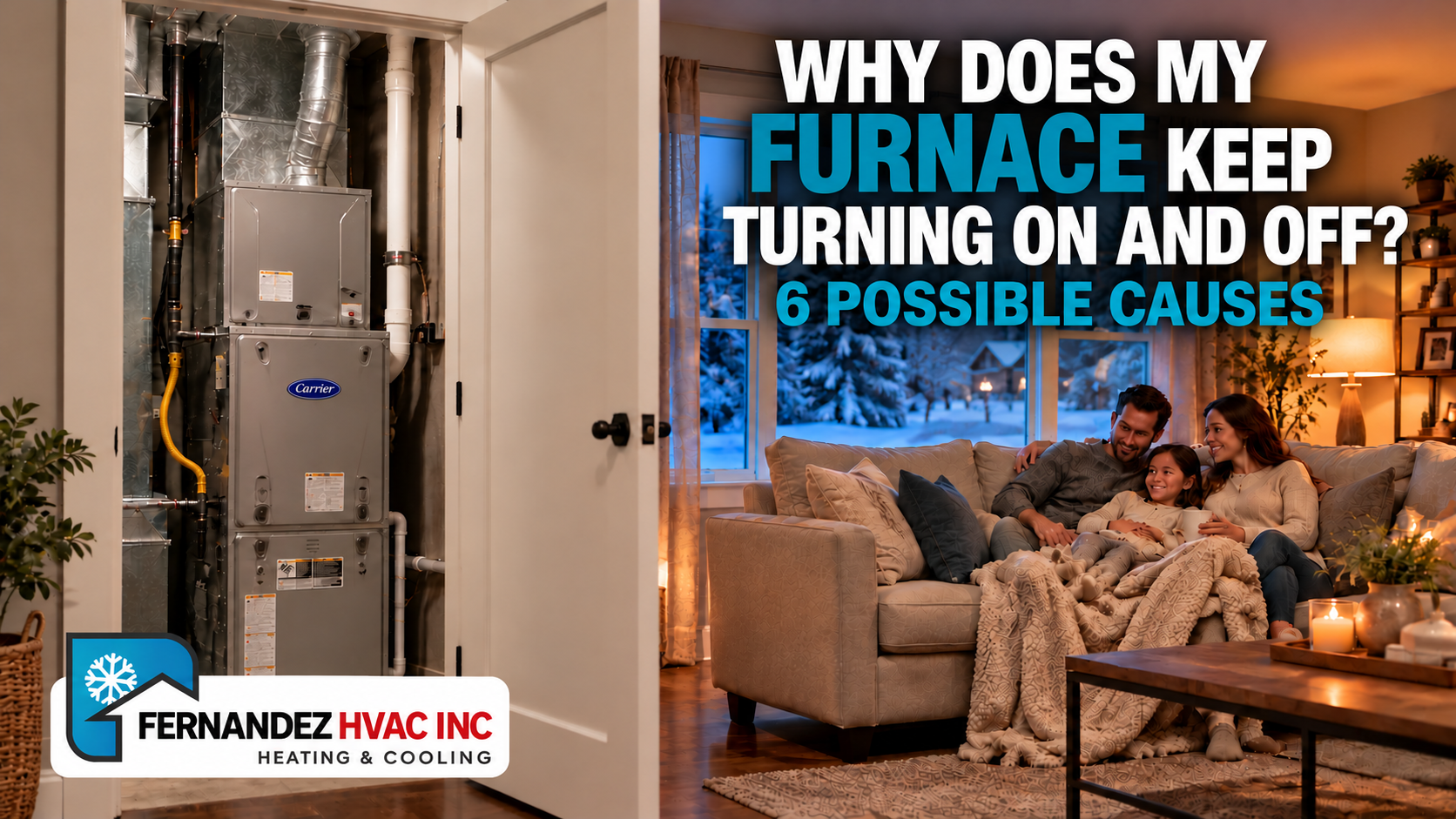
Why Does My Furnace Keep Turning On and Off? 6 Possible Causes
Have you noticed that your furnace turns on, runs for a few minutes, shuts off, and then starts again shortly afterward? If your furnace keeps turning on and off, your heating system may be experiencing a problem known as short cycling.
This behavior can make your home less comfortable, increase energy consumption, and put additional strain on certain furnace components. Although some heating cycles are completely normal, frequent starts and stops may indicate that something needs attention.
Understanding furnace short cycling can help you recognize potential problems before they affect your home’s comfort. As temperatures drop during the fall and winter, it’s important to make sure your heating system is working properly. Understanding the possible causes of furnace short cycling can help you identify what to check and when to contact an HVAC professional.
Here are six common reasons your furnace may keep turning on and off.
What Is Furnace Short Cycling and What Causes It?
Furnace short cycling occurs when a heating system repeatedly turns on and shuts off before completing a normal heating cycle.
Under normal conditions, your furnace starts when the thermostat calls for heat, warms your home, and shuts off after reaching the desired temperature. The length of each cycle depends on factors such as outdoor temperatures, your home’s insulation, and the heating system’s design.
However, if your furnace starts and stops unusually often, it may not be heating your home efficiently.
You might notice that certain rooms remain cold, the temperature fluctuates throughout the day, or the furnace seems to run constantly without keeping your home comfortable.
1. Dirty Air Filter: A Cause of Furnace Short Cycling
One of the most common issues homeowners can check is a dirty air filter.
Your furnace needs sufficient airflow to distribute warm air throughout your home. When the filter becomes clogged with dust, dirt, and other particles, airflow can become restricted.
In some systems, restricted airflow can cause the furnace to overheat and activate a safety limit switch. The burner may shut off to protect the equipment, even though the thermostat is still calling for heat.
A dirty air filter can contribute to furnace short cycling by restricting airflow and causing the system to overheat.
For more guidance, see the ENERGY STAR heating and cooling maintenance checklist.
What should you do?
– Check your furnace air filter regularly.
– Replace it if it is dirty, following the manufacturer’s recommendations.
– Make sure the replacement filter has the correct size and rating for your system.
– Check whether your heating system operates more normally after replacing the filter.
A clean filter is an important part of routine HVAC maintenance. However, if your furnace continues to short cycle after the filter is replaced, another issue may be responsible.
2. Furnace Overheating and Short Cycling
An overheating furnace may shut down before your home reaches the temperature set on the thermostat.
This can happen when airflow is restricted, certain components are not operating correctly, or the system has another mechanical problem.
When the furnace becomes too hot, a safety control may interrupt heating to help prevent damage.
You may notice that the furnace runs for several minutes, shuts off, and starts again after cooling down. Some systems may also stop heating temporarily or display a fault code.
What should you do?
Start by checking the air filter and making sure supply and return vents are not blocked by furniture, rugs, curtains, or other objects.
If the furnace continues to overheat or shut down repeatedly, turn it off and schedule a professional inspection. Do not bypass safety switches or attempt to repair internal furnace components yourself.
An HVAC technician can inspect the airflow, blower motor, safety controls, and other components to determine the cause.
3. Thermostat Problems That Cause Furnace Short Cycling
Your thermostat tells your heating system when to turn on and when to stop heating.
If the thermostat is malfunctioning, incorrectly positioned, or receiving inaccurate temperature readings, it may cause unusual heating cycles.
For example, a thermostat located near a heat-producing appliance, in direct sunlight, or close to a drafty exterior door may read a temperature that does not accurately represent the rest of your home.
Incorrect settings or certain thermostat wiring and control problems may also affect system operation.
What should you check?
– Make sure the thermostat is set to Heat.
– Check that the temperature setting is appropriate for your comfort needs.
– Replace the batteries if your thermostat uses them and indicates they are low.
– Make sure the thermostat is not exposed to direct sunlight or unusual sources of heat.
– Check whether the displayed room temperature seems reasonable.
If the furnace continues turning on and off frequently, an HVAC professional can evaluate the thermostat and its connection to the heating system.
4. Blocked Air Vents or Ductwork Problems
Your heating system relies on a network of ducts and vents to distribute warm air throughout your home.
When supply vents or return-air grilles are blocked, airflow may be reduced. Leaking, damaged, or poorly designed ductwork can also interfere with heating performance.
These problems may cause certain rooms to remain cold while others become warmer. In some circumstances, restricted airflow can contribute to overheating and repeated furnace shutdowns.
Signs of airflow or ductwork problems
– Some rooms never reach the desired temperature.
– Airflow from certain vents is noticeably weak.
– Your furnace runs longer than expected.
– You notice unusual whistling sounds near vents.
– Heating comfort varies significantly between floors or rooms.
What should you do?
Check that furniture, curtains, and other objects are not blocking your vents. Avoid closing numerous vents in an attempt to redirect heat, as this can interfere with the airflow your system was designed to deliver.
If you suspect a ductwork problem, consider scheduling a professional HVAC inspection. A technician can assess airflow, inspect accessible ductwork, and identify possible leaks or restrictions.
5. Your Furnace May Be Oversized
A furnace that is too large for your home may heat the area around the thermostat very quickly and shut off before distributing heat evenly throughout the house.
As the temperature drops again, the thermostat calls for heat and the furnace starts another cycle.
This can create repeated starts and stops, uneven temperatures, and reduced comfort.
Furnace sizing depends on several factors, including the home’s square footage, insulation, air leakage, windows, local climate, and heating requirements. Square footage alone is not enough to determine the correct equipment size.
What should you do?
If your furnace has always cycled frequently or your home has persistent temperature differences, ask an HVAC professional to evaluate the system’s sizing and performance.
Do not assume that you need a replacement simply because the furnace turns on and off frequently. The technician should first investigate simpler possibilities, including filter condition, airflow, thermostat operation, and equipment controls.
If replacement is necessary, a proper heating-load calculation can help determine the appropriate system capacity for your home.
6. A Faulty Flame Sensor or Another Furnace Component
If you have a gas furnace, a dirty or malfunctioning flame sensor may cause the burner to shut off shortly after ignition.
The flame sensor helps confirm that a flame is present. If the system does not detect the flame as expected, its safety controls may shut down the burner.
Other possible causes of repeated shutdowns include ignition problems, faulty control components, pressure-switch issues, or problems with the furnace’s venting system.
These issues require a proper diagnosis because similar symptoms can have different causes.
When should you call a professional?
Contact an HVAC technician if your furnace repeatedly starts and stops, fails to maintain the desired temperature, displays an error code, or has difficulty igniting.
Do not attempt to clean internal sensors, adjust gas components, or repair ignition and safety controls unless you are qualified to perform that work.
A professional can inspect the equipment, identify the underlying fault, and recommend the appropriate repair.
What Can Homeowners Check First?
Before scheduling service, you can perform a few basic checks that do not require opening the furnace or handling electrical or gas components.
Check the air filter. Replace it if it is dirty, following the manufacturer’s instructions.
Inspect accessible vents. Make sure supply and return vents are not blocked by furniture or other objects.
Review your thermostat settings. Confirm that it is set to Heat and that the temperature setting is appropriate.
Observe the heating cycle. Note how long the furnace runs before shutting off and whether the problem happens repeatedly.
Look for error codes. If your thermostat or furnace displays a code, record it for the technician. Do not remove access panels or defeat safety controls to find it.
If these simple checks do not resolve the issue, professional troubleshooting is the safest next step.
When to Call a Professional for Furnace Short Cycling
A furnace that turns on and off occasionally is not necessarily malfunctioning. However, repeated short cycles deserve attention, particularly when the home is not heating properly.
Consider scheduling professional heating service if:
– Your furnace repeatedly starts and stops within short intervals.
– Your home remains cold despite the thermostat calling for heat.
– Some rooms are consistently warmer or colder than others.
– You notice unusual noises or a sudden increase in energy use.
– Your furnace displays an error code or shuts down unexpectedly.
– Replacing the air filter does not improve operation.
Important safety warning: If you smell gas or rotten eggs, leave the area and contact your gas utility or emergency services from a safe location. Avoid flames, sparks, and electrical switches if a gas leak is suspected. If a carbon monoxide alarm sounds, get everyone outside immediately and call emergency services. Carbon monoxide is odorless, so never rely on smell to detect it.
A qualified HVAC technician can inspect the furnace, test its operating controls, evaluate airflow, and determine why the system is shutting down prematurely.
Keep Your Home Warm With Professional Furnace Short Cycling Repair
When your furnace keeps turning on and off, the problem may be as simple as a dirty air filter or as complex as a faulty component or equipment-sizing issue.
Identifying the cause early can help restore consistent heating, reduce unnecessary cycling, and prevent a minor problem from becoming a more serious equipment issue.
At Fernandez HVAC Inc., we help homeowners throughout Virginia, Maryland, and Washington, D.C. with heating and cooling services, including maintenance, troubleshooting, and repairs.
Whether your furnace needs a seasonal checkup or a professional diagnosis, our goal is to help you understand the problem and find an appropriate solution for your home.
Is Your Furnace Ready for Winter?
Don’t wait until the coldest day of the year to address a heating problem.
If furnace short cycling continues, a professional inspection can help identify the cause and restore reliable heating.
If your furnace keeps turning on and off, isn’t heating properly, or needs seasonal maintenance, contact Fernandez HVAC Inc. to schedule professional heating service.
Fernandez HVAC Inc. — Our Experience in Your Hands.


Recent Posts